Urbzag.com - Discontinued
Timeline: 2019
Platform: Web + Mobile (Cross-platform)
Primary User: Homeowners, buyers/renters, real estate agents
Status: Launched · Discontinued
How I co-led the 0→1 design of Urbzag, a PropTech platform that disrupted Portugal's real estate market and earned a Web Summit ALPHA selection
Urbzag needed to do something rare in real estate: make both sides of a transaction (homeowners and agents) feel equally served by the same platform. I co-led design strategy, UX, UI, brand, and service design from concept to launch, building a product that was selected by Web Summit ALPHA 2019 as one of Portugal's most promising startups.
Strategic Frame
Incumbent Portuguese property platforms (Idealista, Imovirtual) competed on inventory. Urbzag's proposition was structurally different: compete on information transparency. Where incumbents surfaced what agents wanted buyers to see, Urbzag would surface what buyers and sellers needed to make an informed decision, including the methodology behind every valuation, the performance data behind every agent, and the market dynamics that incumbents had commercial reasons to obscure.
This wasn't a feature strategy. It was a trust paradigm shift. The product's commercial bet was that in a market where trust was the primary conversion driver, the platform that was most transparent would win, even against incumbents with larger inventories.
The design challenge was to make that transparency feel trustworthy, not overwhelming. Showing all the data was easy. Making it legible, navigable, and meaningful to homeowners and agents who were not data analysts was the design problem.
Context & Scope
Portugal's residential property market in 2019 was structurally opaque. Property valuations were inconsistent and difficult to verify. Agent selection was informal and trust-dependent. Buyers and sellers moved through fragmented platforms with no reliable access to market data.
HHSurge's proposition was Urbzag: a platform bringing data-driven property valuation, structured agent matching, and transparent market intelligence to a market that had resisted digitisation. The commercial model only worked if both sides (homeowners and agents) found genuine value simultaneously.
I joined as Senior Product Designer alongside Patrícia Pereira. I owned: design strategy, UX architecture, brand identity, and the valuation tool interaction model. Patrícia owned: UI system execution and mobile experience depth. We shared: research facilitation, prototype testing, and Web Summit presentation. From blank canvas to a live product presented at Web Summit Lisbon, November 2019.

My Role & Leadership
- Co-led the full design programme alongside Patrícia Pereira
- Owned design strategy, research methodology, and the dual-audience information architecture
- Owned brand design end-to-end: logo, identity system, illustration style, voice and tone guidelines
- Designed the property valuation tool, the platform's primary acquisition hook and trust mechanism
- Led prototype testing with homeowners and real estate agents through multiple iterations
- Made the prioritisation calls about what shipped at launch and what was deferred
- Prepared and contributed to the Web Summit ALPHA application, representing the product at Booth A-503 in November 2019 to an audience of 70,000+ technology and investment professionals.
Problem Statement
The core design problem was structural. Most real estate platforms choose a side. Urbzag's commercial model only worked if both sides felt genuinely served (with different value propositions, different information hierarchies, and different primary actions) while sharing the same underlying data layer and maintaining a coherent visual identity.
For homeowners: Property valuations from agents were perceived as commercially motivated. There was no independent, data-driven benchmark, no way to know whether the number you were given was accurate or strategic.
For agents: Listing across multiple platforms required duplicate data entry. Independent agents had no way to make their quality visible. The market rewarded familiarity over competence.
Shared: Information asymmetry was built into the structure of the market. Buyers had no access to price trend data, comparable sales, or realistic time-to-sell estimates. This benefited established players at the expense of everyone else.
"I was told my house was worth three different amounts by three different agents. I had no way of knowing who was right."
Research
Our research covered field studies with homeowners and agents, structured stakeholder interviews, social media sentiment analysis of the Portuguese property market, competitive benchmarking, and quantitative survey analysis.
The most significant finding: trust was the primary conversion driver, more than price, features, or UX quality.
- Control signals trust. Homeowners who could see exactly how their valuation was calculated rated the platform as significantly more trustworthy than those who received a number with no explanation. Showing the working was not a feature; it was the trust mechanism.
- Agents needed efficiency, not prestige. Speed of listing creation, quality of lead filtering, and clarity of enquiry management were their top priorities. A beautiful interface that was slow was worse than a functional interface that was fast.
- Buyers follow a decision sequence. Users moved through a consistent mental order: price range → location → property type → agent contact. Interfaces that disrupted this sequence created friction and drop-off. The information hierarchy had to follow the decision process.
- Mobile was the primary discovery surface. Over 65% of initial searches in user testing were on mobile. Desktop was used for comparison and commitment. We designed mobile-first and ensured desktop depth for the evaluation phase.
Key Design Decisions
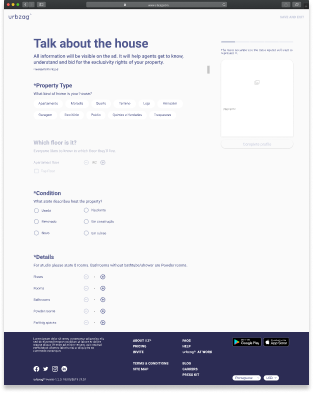
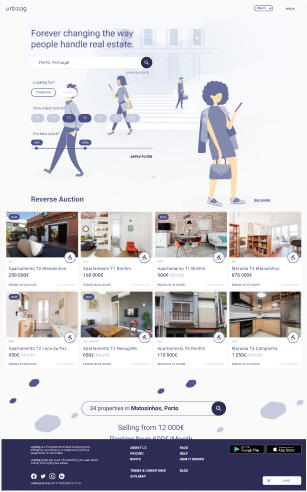
Valuation tool as first interaction, before account creation. Rather than requiring commitment before delivering value, the platform's first interaction was an immediate, data-driven property assessment. This reduced abandonment and established trust at the first contact point, giving homeowners something tangible before any registration friction.
Dual-entry IA: two paths, one platform. The information architecture was designed with two distinct entry paths, homeowner and agent, sharing a visual language and data layer but surfacing different primary actions and information hierarchies. Neither persona's experience was subordinated. The structural challenge was ensuring the shared navigation didn't feel like a compromise for either.
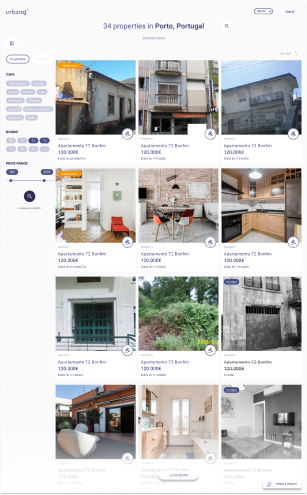
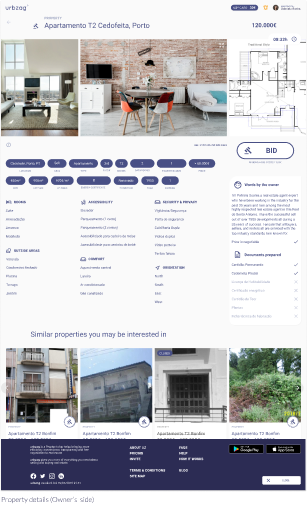
Agent profiles structured around verifiable performance. Agent profiles were not directories. They were structured around verifiable criteria: neighbourhood specialisation, average days-to-sell, transaction volume. This made agent quality visible in a market where it had previously been invisible and gave homeowners an objective basis for selection rather than proximity or word-of-mouth.
Real-time market insights as ambient context. Price trends, comparable sales, and time-to-sell benchmarks were embedded contextually throughout the interface and surfaced at the moment of decision, not sequestered in a separate analytics section.
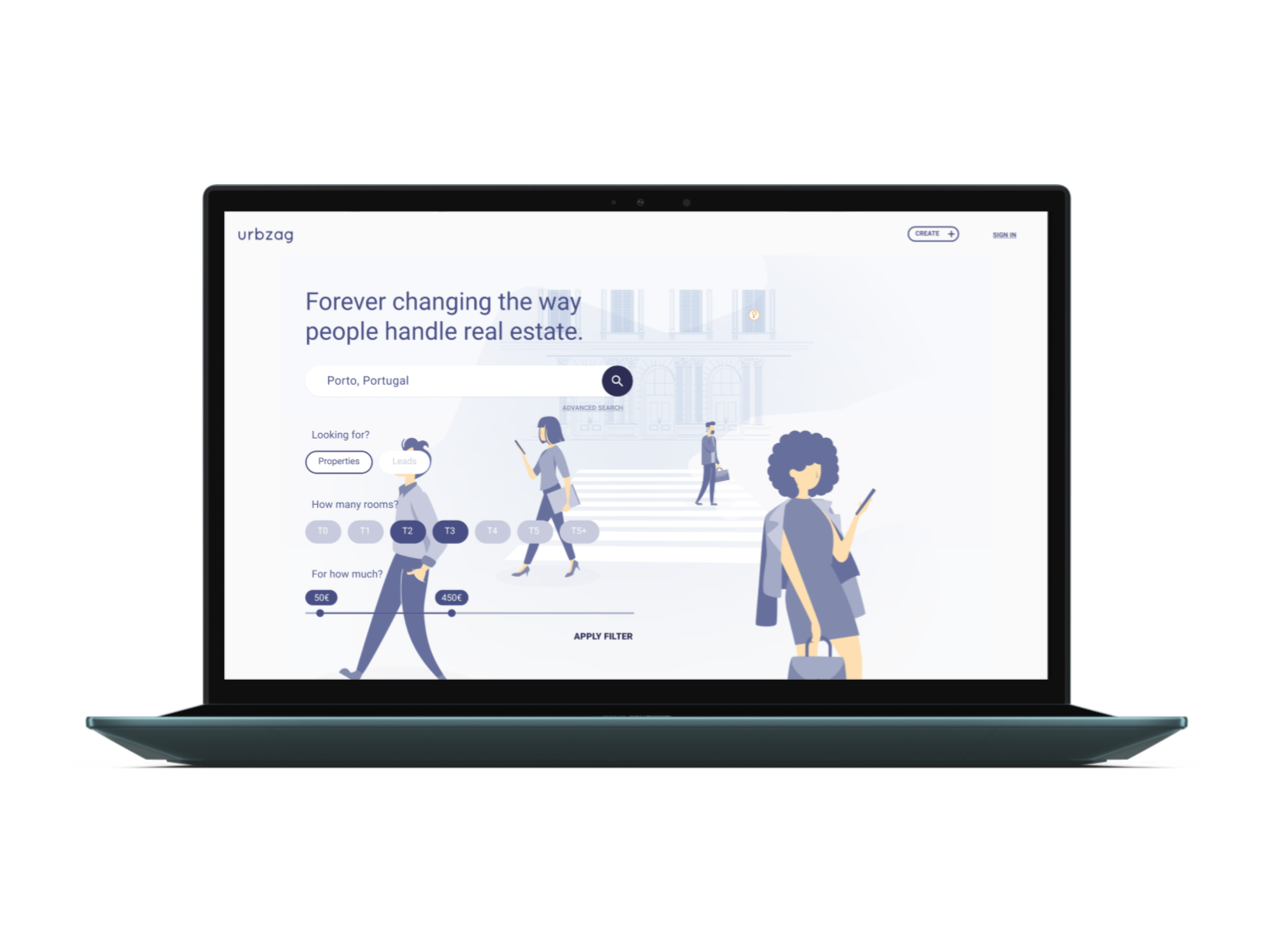
Illustration as trust language. The illustration system explained complex real estate concepts (valuation methodology, contract stages, agent commission structures) in accessible, non-threatening visual language. This was deliberate: demystifying processes that had historically benefited from opacity was both a UX decision and a brand decision.
What was cut for launch, and why. The original roadmap included a buyer-facing mortgage comparison tool and a historical transaction database. Both were deferred. The decision was anchored in a single research signal: trust-building in the platform came before depth of features. Users who didn't trust the valuation number wouldn't use the mortgage tool. Features that assumed prior trust were deferred until the trust foundation was built. That discipline kept the launch coherent and the team focused.
Impact & Results
ALPHA
Selected for Web Summit ALPHA 2019, one of Portugal's most competitive startup programmes at the world's largest tech conference
70k+
Technology and investment professionals reached at Web Summit, international exposure driving early partnership conversations
High
User satisfaction in prototype testing, particularly around control, transparency, and trust. The platform's primary design goals
0→1
Full brand, product, and service design delivered (from concept to live, publicly-presented platform) within a startup timeline

Lessons as a design leader
Transparency as a competitive strategy, not a design principle. Incumbents hid information because transparency threatened their position. Urbzag's transparency was its position. The design decision to show valuation methodology was strategically motivated, not just ethically motivated. That distinction matters for how you argue for it internally.
Designing for two audiences simultaneously requires finding the shared foundation first. The temptation is separate products. The craft is finding what both audiences need in common — a coherent data layer, a trustworthy visual language, a valuation tool both sides can reference and building the differentiated experience on top of that foundation.
Startup timelines require prioritisation anchored in a single, specific principle. Not "prioritise research signals." Specifically: "Defer features that assume trust we haven't earned yet." That principle was the filter for every launch scope decision. It kept the product coherent when timeline pressure pushed for scope expansion.
Brand design is product design. The illustration system and the UX were equally influential on user trust. Treating them as separate workstreams would have produced a less coherent result. In a market where credibility is everything, the visual language of the product is a direct signal of the product's values.