Timeline: June 2023 – October 2025
Phase: Discovery → MVP
Primary User: Berth Planner, Operations Manager
Key Methods: User interviews, task analysis, prototyping, usability testing
Domain: Port logistics / berth planning
Business Goal: Increase berth occupancy & SLA adherence
Designing AI-assisted berth planning workflows for smarter coordination and faster vessel turnaround
AICON Berth replaced fragmented spreadsheet workflows with a real-time, AI-driven berth allocation tool. Helping terminal planners maximize throughput, protect SLAs, and make confident decisions under time pressure.
Context & Scope
Every vessel arrival requires a berth allocation, a window of time at a specific location, with cranes and labour assigned, physical constraints checked, and SLA commitments protected. A well-planned berth schedule flows invisibly. A poorly planned one cascades: vessel delays trigger crane reallocation, which triggers yard congestion, which triggers gate queues, which triggers customer complaints and commercial penalties.
Most terminals managed this with a combination of legacy TOS interfaces, spreadsheets, and the accumulated knowledge of experienced planners. The process was opaque, difficult to audit, and impossible to optimise at scale. Planners were exceptionally skilled, but they were compensating for tools that offered no real-time feedback, no automated conflict detection, and no support when vessel ETAs shifted at 2am.
The brief was to design a berth planning module with AI-assisted recommendations, real-time conflict detection, and multi-scenario comparison. The harder constraint: don't break the mental models of people who've been doing this job for twenty years.
Berth Planing — Production Gantt. Live vessel allocations across 8 berth positions (th4–th8) over a 9-day rolling window. Colour coding: vessel type and carrier. Conflict indicators surface inline. — DCT terminal, May 2025.
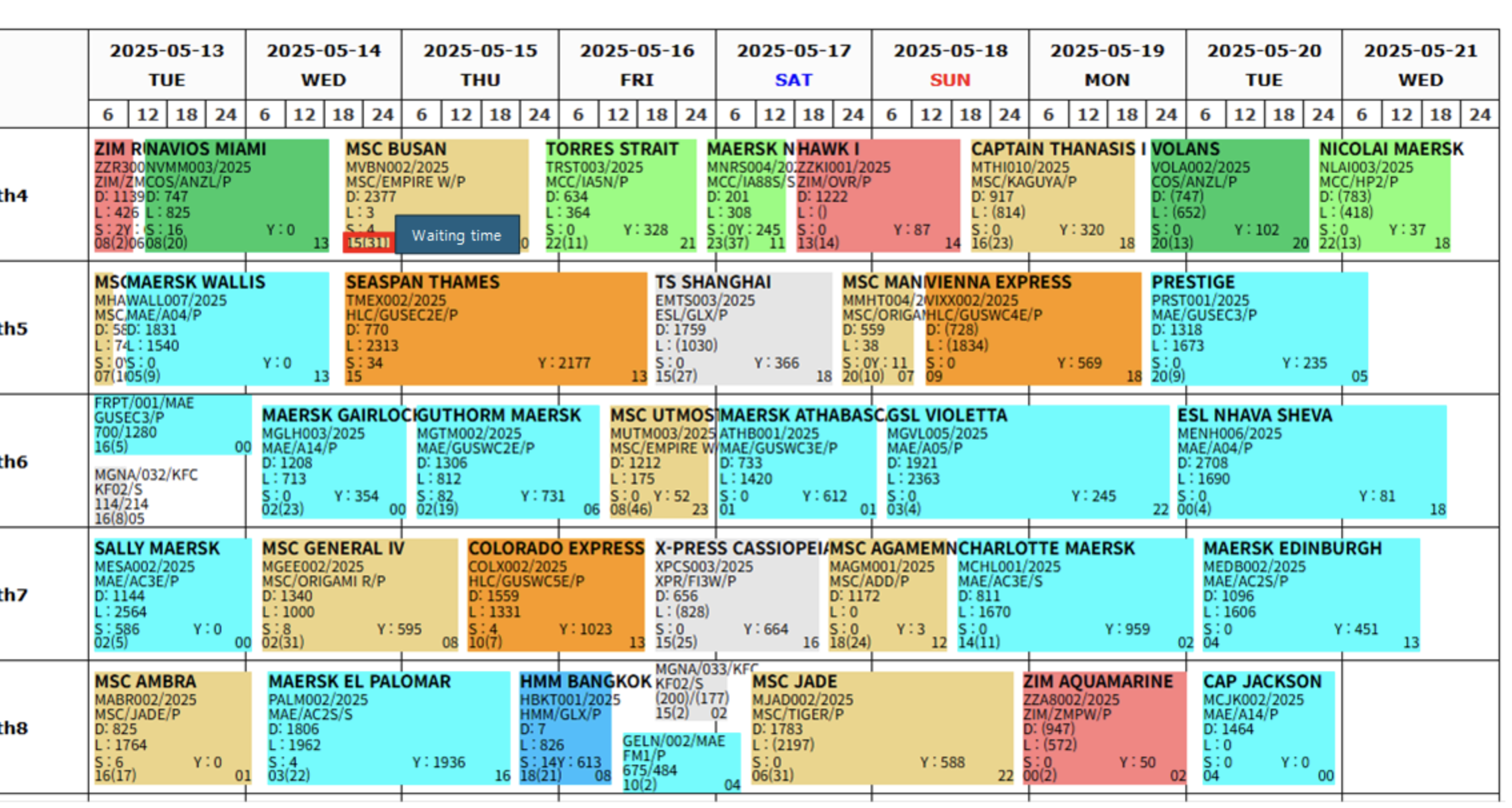
Berth Planing — Production Gantt. Live vessel allocations across 8 berth positions (th4–th8) over a 9-day rolling window. Colour coding: vessel type and carrier. Conflict indicators surface inline. — DCT terminal, May 2025.
My Role & Leadership
- Led full design process from discovery through MVP prototype, with no prior design on the module
- Defined the research plan and facilitated interviews with berth planners across two distinct terminal profiles
- Ran structured competitive benchmarking against Portchain Connect, Awake.AI, and Kaleris TOS, documenting feature gaps and interaction patterns that informed our differentiation strategy
- Facilitated cross-functional kickoff aligning product, engineering, and sales on scope and success metrics
- Led prototype testing sessions with live berth planners across multiple design iterations
- Defined the interaction model for AI-assisted recommendations, confidence display, rationale, and override mechanics
- Designed the connection points between Berth and adjacent AICON modules (Yard, Dispatch) to ensure the data model supported cross-module decision chains
Problem Statement
Berth planners were managing a highly dynamic, constraint-heavy scheduling problem with tools that gave them no feedback, no early warning, and no support when circumstances changed. The commercial exposure was not theoretical: in port contracts, SLA breaches carry financial penalties measured in tens of thousands of euros per incident. A planning tool that caught a breach before commitment was worth more than its entire development cost in the first prevented penalty.
Key pain points uncovered in research:
No automated SLA monitoring. Planners discovered SLA breaches through experience, not the system. By then, options were limited and the penalty was often unavoidable.
Resource constraints checked separately. A berth window could be confirmed before crane availability or labour gang capacity had been verified against it.
ETA changes required manual re-planning. Vessel ETAs shift constantly. Every change triggered a manual reconciliation process with no tooling suppor. A significant cognitive burden during active port operations.
No shared, auditable plan. Different stakeholders were working from different versions of the plan. Coordination failures were common and hard to trace.
"The plan I make at 8am is already wrong by 10am. I need the system to tell me that before it costs us."
Berth Planing — Production Gantt. Live vessel allocations across 8 berth positions (th4–th8) over a 9-day rolling window. Colour coding: vessel type and carrier. Conflict indicators surface inline. — DCT terminal, May 2025.
The Core Design Tension
Every AI-assisted planning tool faces the same fundamental tension: if the AI is confident enough to make a recommendation, it should probably just make the decision. But in berth planning, the AI doesn't have access to all the relevant variables. A planner knows that Vessel X's agent always calls to request a specific quay position. That the crane team supervisor prefers a particular assignment sequence on Mondays. That the terminal's biggest customer is arriving and the commercial relationship overrides the algorithmic optimum.
Planners need the AI to be smart enough to be useful but humble enough to be trustworthy. The interaction model had to resolve this tension explicitly, not paper over it.
Our answer was a three-layer model: AI recommendation with visible confidence and top constraint → planner review with inline edit capability → explicit accept or override, with the override feeding back into the model. Every override made the model smarter. Every acceptance validated it. The system learned from expert judgement rather than competing with it. And planners who overrode consistently saw their override rates decline as the model adapted. A feedback loop that built trust through demonstrated learning, not through claimed accuracy.
Research & Insights
I designed and ran a research programme combining task analysis, cognitive walkthrough interviews, and scenario-based prototype testing with berth planners across two terminal operator profiles.
Critical design insights:
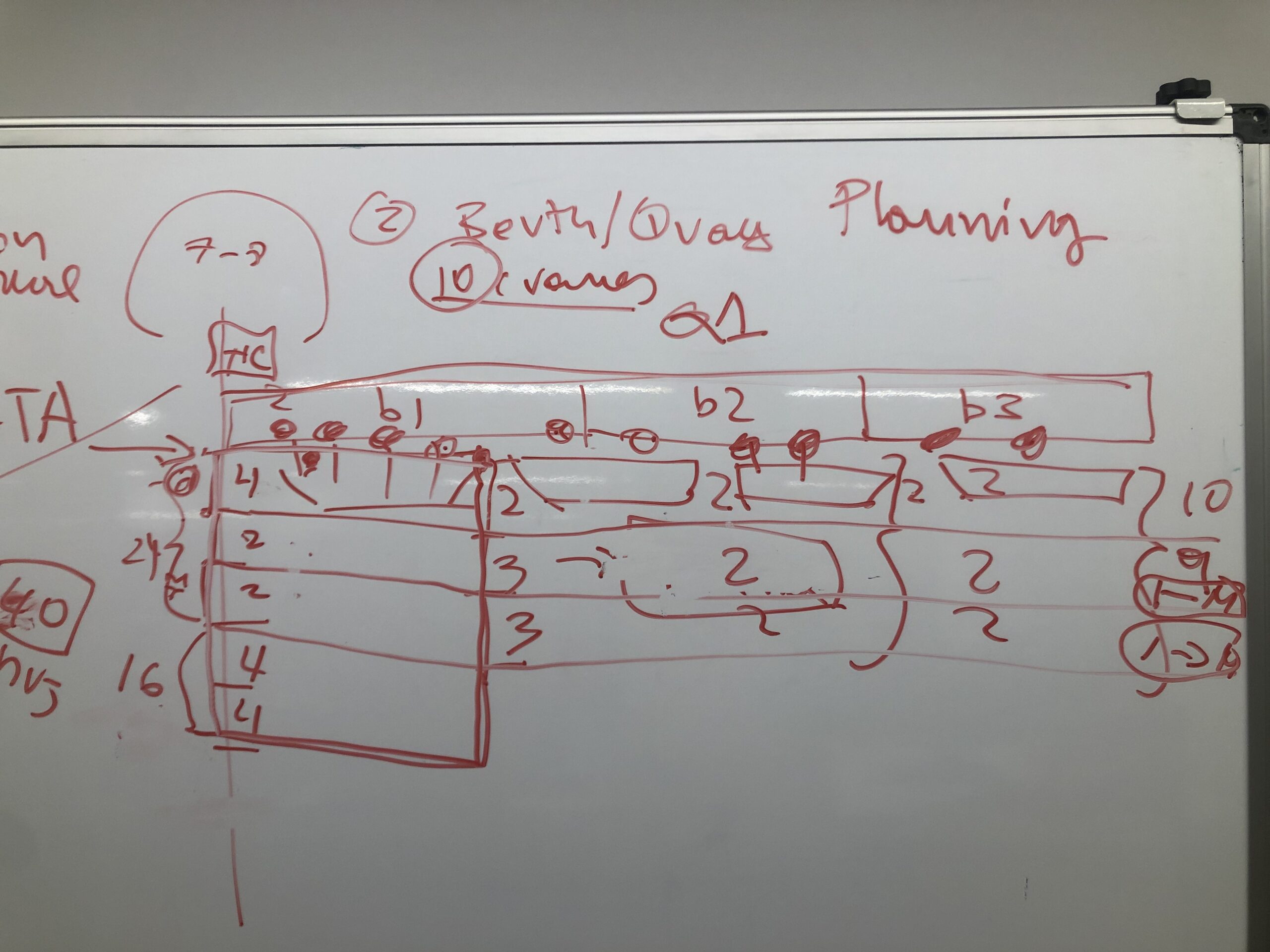
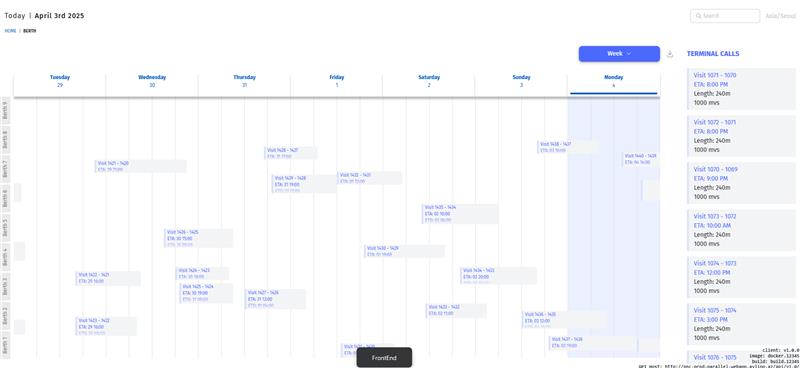
The Gantt is non-negotiable. Experienced planners think in time and space simultaneously. Any interface that couldn't represent a berth timeline visually would fail adoption regardless of its feature depth. We committed to a drag-and-drop Gantt as the primary interaction surface, not because it was the most technically elegant option, but because planners already thought in those terms.
AI suggestions must be skimmable, not verbose. Planners under peak-hour pressure have seconds to evaluate a recommendation. Testing showed that a single-line format (recommended window + confidence level + top constraint) outperformed detailed recommendation panels on both speed and trust.
Conflict warnings must be preventive, not punitive. Early prototypes flagged conflicts after a planner had committed to a window. Testing showed this created frustration and, in some cases, distrust of the system, planners interpreted post-commit flags as the system "catching them out" rather than helping them. Moving conflict detection to an ambient pre-commit layer was one of the highest-impact single decisions on the project.
Scenario comparison is a power feature with no good competition. Senior planners consistently described wanting to model two or three alternatives before committing. Every competitor tool we reviewed handled this poorly or not at all. That gap became our strongest differentiating feature.
Berth Planing — Production Gantt. Live vessel allocations across 8 berth positions (th4–th8) over a 9-day rolling window. Colour coding: vessel type and carrier. Conflict indicators surface inline. — DCT terminal, May 2025.
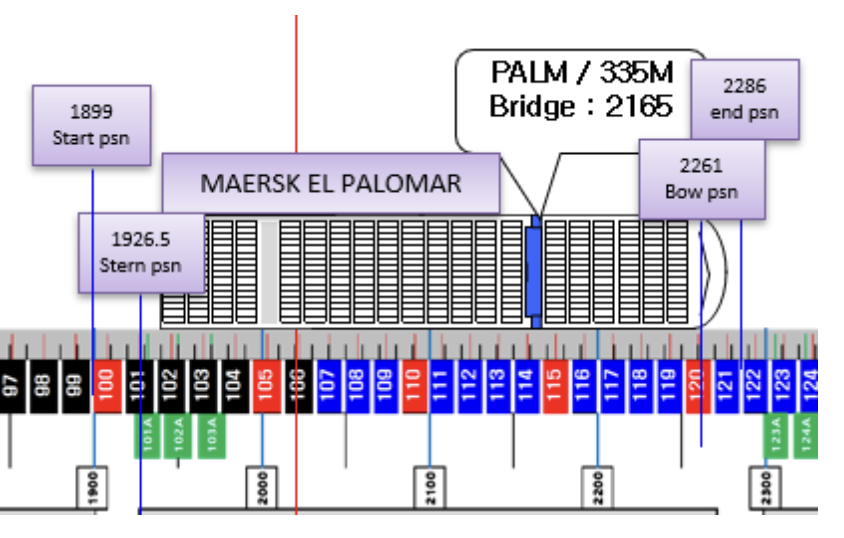
Berth Planing — Production Gantt. Live vessel allocations across 8 berth positions (th4–th8) over a 9-day rolling window. Colour coding: vessel type and carrier. Conflict indicators surface inline. — DCT terminal, May 2025.
The Solution & Key Design Decisions
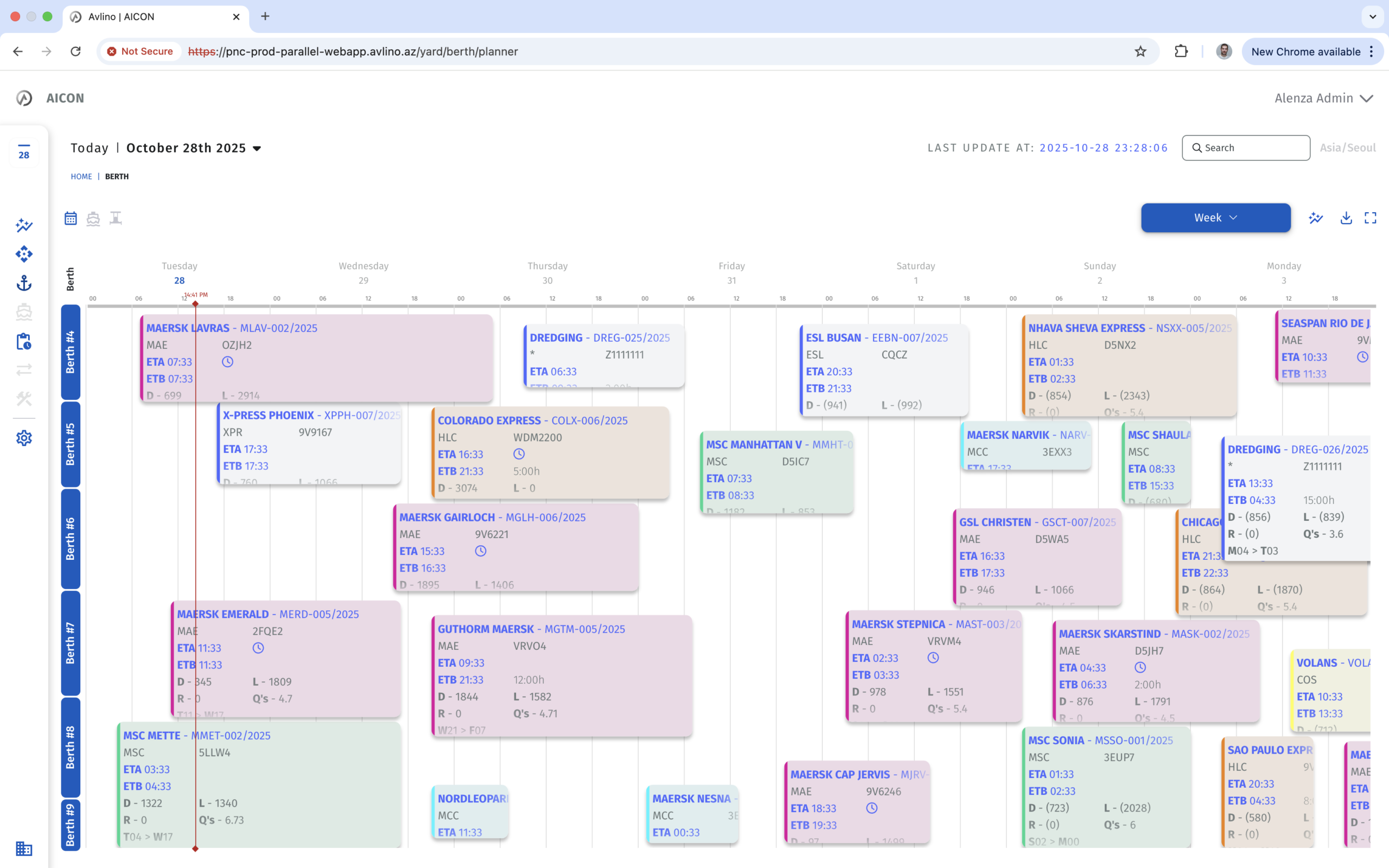
Berth Planing — Production Gantt. Live vessel allocations across 8 berth positions (th4–th8) over a 9-day rolling window. Colour coding: vessel type and carrier. Conflict indicators surface inline. — DCT terminal, May 2025.
AI-assisted berth recommendations with visible rationale. The system proposes optimised berth windows based on vessel characteristics, occupancy, crane availability, and SLA requirements. Each recommendation displays a confidence level and a top-three constraint rationale. Planners accept, adjust, or reject. Rejections feed back into the model. We learned in testing that users ignored a percentage confidence score in isolation, but trusted the same information when paired with the constraint that drove it. Transparency is a conversion mechanism, not a courtesy.
Ambient pre-commit conflict detection. As a planner drags a vessel to a window, real-time conflict indicators surface inline (crane availability, labour gaps, SLA risk) before any commitment is made. The system intervenes early enough to be useful, not late enough to be punitive. This was the single most impactful decision in the usability testing cycle, producing the largest measurable improvement in planner confidence between prototype rounds.
Scenario builder. Planners can fork the current plan into up to three parallel scenarios, adjust each independently, and run a side-by-side comparison on key KPIs (berth utilisation, SLA adherence, resource cost) before committing to one. No competitor had solved this well. We made it the feature we invested most in getting right.
Live ETA propagation. AIS data feeds vessel ETAs continuously. When a vessel shifts, the system recalculates downstream impacts and surfaces them as prioritised, contextual alerts, not buried notifications. The plan stays current without manual reconciliation.
Cross-module connection: Berth → Yard → Dispatch. Berth planning doesn't end at the quay. A vessel allocation triggers downstream decisions: where containers will be staged in the yard, which trucks will be dispatched, which crane teams will be assigned. The Berth module was designed with explicit data connections to the Yard and Dispatch modules, so that a change to a berth window propagated as a recalculation request to adjacent planning surfaces, not as an invisible upstream dependency that other planners would discover too late.
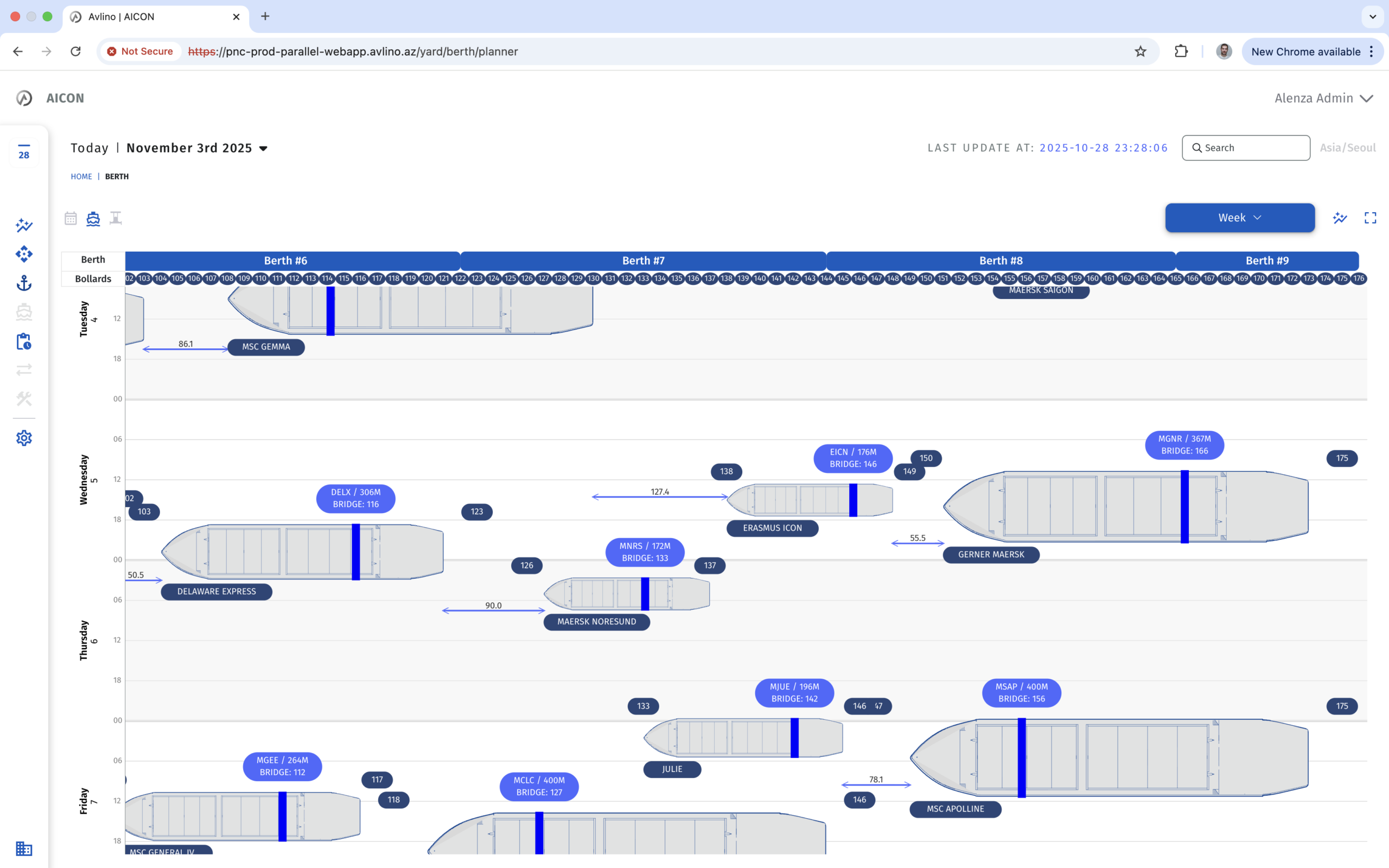
Berth Planing — Production Gantt. Live vessel allocations across 8 berth positions (th4–th8) over a 9-day rolling window. Colour coding: vessel type and carrier. Conflict indicators surface inline. — DCT terminal, May 2025.
Impact & Results
AICON Berth progressed from discovery to MVP prototype with active pilot engagement at terminal operator level. Benchmarking against comparable implementations of AI-assisted berth planning tools informed conservative but credible outcome estimates:
~30%
Estimated reduction in manual re-planning cycles during vessel ETA changes
~20%
Projected improvement in berth utilisation vs. spreadsheet-managed baselines (industry benchmark)
3×
Faster scenario comparison versus manual methods in prototype usability sessions
↑ SLA
Proactive SLA breach detection designed to reduce reactive penalties at contract-critical terminals
Override-fed model learning
Designed mechanism to improve AI recommendation accuracy through planner expertise, not despite it
Lessons as a design leader
Respecting existing mental models isn't a constraint. It's a strategy. The Gantt chart wasn't the most technically elegant solution. It was the right one because planners already thought in those terms. Meeting people in their cognitive model is a more reliable path to adoption than asking them to learn a new one.
AI confidence is meaningless without AI rationale. We learned this empirically: users who saw only a percentage score ignored it. Users who saw the constraint driving that score trusted it and acted on it. Transparency in AI recommendations isn't an ethical nicety, it's a UX requirement.
The most important design decision on this project was a timing decision. Moving conflict detection from post-commit to pre-commit changed the emotional register of the tool from accusatory to supportive. The underlying logic was identical. The interaction moment was everything.
Competitive benchmarking should surface differentiation, not convergence. We identified scenario comparison as our strongest differentiating feature precisely because every competitor handled it badly. The gap in the market was visible in the research. We just had to be willing to invest in solving it properly.
Design the system, not just the module. The Berth module's value to AICON as a suite was only fully realised when its data connections to Yard and Dispatch were explicit. A standalone berth planner is useful. A berth planner that propagates changes downstream is transformative. That distinction required design to think at the system level before the interface level.